

Your Heart Rate
Heart Rate Calculator
Classic method, Karvonen method, and personalized training zones
| Zone | % intensity | Heart rate | Purpose |
|---|---|---|---|
| Run a calculation to display your heart rate zones. | |||
| Marker | Value |
|---|---|
| Run a calculation to display your markers. | |
• Classic method: based on theoretical maximum heart rate, or your known max heart rate if you provide it.
• Karvonen method: more individualized because it takes your resting heart rate and heart rate reserve into account.
• Zones: useful for structuring recovery, endurance, threshold, and high-intensity work.
Fc and Training
Heart rate (HR) is one of the most widely used physiological indicators for assessing and measuring the intensity of your physical effort, tracking your progress, and optimizing your training and recovery.
Heart rate varies depending on your age, fitness level, emotional state, temperature, and the intensity of your physical activity.
To perform well and make progress, it is very important to understand how your heart rate responds to exercise.
Heart rate (HR) is a key biomarker for assessing the cardiovascular system’s response to exercise.
Measuring your heart rate allows you to:
-
Optimize the intensity of your workouts and control your training load.
-
Estimate the demand on the energy systems used.
-
Improve your endurance and interval performance.
-
Monitor your recovery, measure fatigue, and prevent overtraining
- Define training zones (Z1 to Z5)
From a physiological point of view, heart rate is studied in relation to actual energy demand, oxygen utilization (VO₂), heart rate variability (HRV), and ventilatory thresholds, which determine effective training zones.
HR allows you to assess the intensity of your training in real time, measure and monitor your recovery, and optimize your sessions.
“The best don’t train more: they train better…”
Heart Rates
-Resting heart rate - (RHR) -
This is the heart rate when the body is at complete rest. It is a key indicator of cardiorespiratory fitness. A lower RHR generally indicates better fitness.
- Heart rate reserve - (HRR) -
Heart rate reserve is the difference between MHR and HRR. It is used in the Karvonen formula to determine training zones.
-Maximum heart rate - (MHR) -
The MHR represents the maximum number of beats the heart can reach during intense exercise. It is often estimated by:
-
Simple method → 220 – age (men) or 226 – age (women)
-
More accurate and scientific methods (Karvonen, laboratory tests, field tests)

Karvonen method and heart rate reserve
The Karvonen method uses heart rate reserve to individualize intensity zones. By incorporating HRR, it better reflects actual physiological condition than simply using a percentage of MHR.
- Formula -
Calculation of heart rate reserve HRR:
HRR = MHR – HR
→ This corresponds to the heart rate range that can be achieved between rest and maximum effort.
Target heart rate calculation THR:
THR = (HRmax × % intensity) + HRrest
→ It aligns HR with VO₂ reserve for precise intensity control.
- Karvonen vs %FC -
- The HRR reflects parasympathetic tone (fitness, fatigue, stress).
- Karvonen calculates intensity from rest, the actual physiological baseline.
- The almost linear relationship between HRR and VO₂ reserve makes it a reliable tool.
-
It thus provides a more accurate estimate of internal effort.
Karvonen provides a more accurate estimate of intensity by combining maximum available capacity and physiological reality at rest, two essential markers in high performance.
Target Zones
Target heart rate zones allow you to structure your training according to the desired physiological adaptations and energy systems used.
They are expressed as a percentage of MHR or a percentage of HRR (Karvonen), the latter being more accurate.
- Zone 1 — Recovery / Very light endurance -
50–60 % MHR
50–60 % HRR
Physiological Effects :
-
Gentle parasympathetic activation
Helps the body calm down and reduce physiological stress. -
Improved circulation and waste clearance
Speeds up the removal of metabolic by-products. -
Enhanced muscle oxygenation
Delivers more oxygen without adding fatigue. -
Reduced muscle tension and stiffness
Promotes relaxation and better mobility. -
Very low neuromuscular load
Protects joints and the nervous system — ideal on low-energy days. -
Support for active recovery
Keeps training consistent while aiding regeneration. -
Improved readiness for upcoming sessions
Maintains light activation to prepare the body for further work. -
Greater autonomic system balance
Encourages parasympathetic activity for deeper recovery. -
Foundational base for all training zones
Essential for progressing safely and avoiding overload.
Typical Uses :
-
Warm-ups & cool-downs, Active recovery days, Fatigue or deload days, Transition runs/rides…
- Zone 2 — Aerobic Endurance -
60–70 % MHR
60–70 % HRR
Physiological Effects :
-
Development of aerobic capacity
Builds strong, efficient cardiovascular function. -
Increased mitochondrial density
Improves cellular energy production. -
Enhanced oxygen transport
Better delivery and utilization of O₂ throughout the body. -
Greater fat-oxidation efficiency
Encourages the use of fat as a primary fuel source. -
Lower lactate production
Keeps effort sustainable with minimal metabolic stress. -
Improved metabolic flexibility
Allows smoother transitions between energy systems. -
Stronger slow-twitch muscle fibers
Reinforces the fibers responsible for long-duration efforts. -
Essential base of performance
Supports progress in all higher training zones.
Typical Uses :
-
Long steady sessions, Base-building periods, General conditioning, Endurance sports (running, cycling, rowing…), Fat-metabolism development blocks…
- Zone 3 — Tempo / High Aerobic -
70–80 % MHR
70–80 % HRR
Physiological Effects :
-
Improved ventilatory threshold 1 (VT1)
Raises the intensity you can sustain while remaining aerobic. -
Stable, controlled sustained effort
Trains the body to maintain pace efficiently. -
Development of high-end endurance
Enhances performance at moderate–high intensities. -
Increased lactate clearance
Recycles lactate more effectively as usable fuel. -
Enhanced muscular oxidative capacity
Improves O₂ usage in type I and IIa muscle fibers. -
Improved cardiac stroke volume
Boosts the heart’s pumping efficiency. -
Greater glycogen sparing
Uses fat more effectively at higher outputs. -
Strengthened respiratory musculature
Increases resistance to breathing fatigue. -
Higher tolerance to metabolic stress
Maintains effort without excessive cardiac drift. -
Better pace control
Improves steady-state efficiency and rhythm management.
Typical Uses :
-
Continuous tempo efforts, Sustained steady-state work, Sweet spot training (cycling), Preparing for long threshold efforts, Pace control training…
- Zone 4 — Threshold / Anaerobic -
80–90 % MHR
80–90 % HRR
Physiological Effects :
-
Improved lactate threshold (LT / VT2)
Increases the intensity you can sustain before lactate accumulates rapidly. -
Enhanced buffering capacity
Better management of acidity during hard efforts. -
Greater recruitment of intermediate muscle fibers (IIa)
Builds durability at strong, race-pace intensities. -
Improved maximal steady-state performance
Raises your ability to maintain fast, demanding efforts. -
Increased cardiac output under high stress
Trains the heart to work efficiently at near-max intensities. -
Sharper mental focus and resilience
Strengthens tolerance to discomfort and effort.
Typical Uses :
-
Threshold intervals, Race-pace preparation (10 km → half-marathon, time-trials…), “Controlled hard” sessions, Key sessions for competitive athletes…
- Zone 5 — VO₂ Max / High-Intensity -
90–100 % MHR
90–100 % HRR
Physiological Effects :
-
Maximal oxygen uptake stimulation (VO₂ Max)
Expands the body’s top aerobic ceiling. -
Increased stroke volume and cardiac contractility
Maximizes the heart’s capacity per beat. -
Higher capillary recruitment
Improves blood flow to fast-twitch fibers. -
Greater fast-twitch fiber activation (IIx / IIb)
Boosts peak power and high-intensity capability. -
Rapid improvements in aerobic power
Enhances speed, acceleration, and overall athletic capacity. -
Improved tolerance to severe intensity
Helps manage the stress of racing, surges, and intervals.
Typical Uses :
-
VO₂max intervals, Short high-intensity repeats, Performance peaks & race-specific sharpening, Sports requiring repeated high-power efforts
FC and Training Cycle
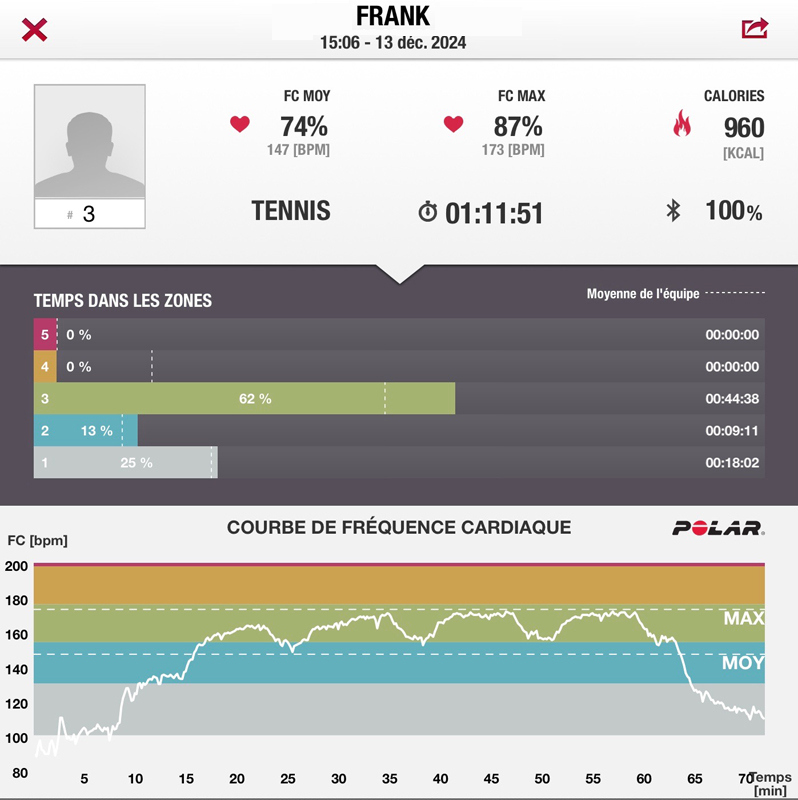
Heart rate analysis is becoming a strategic tool for guiding training cycles, anticipating fatigue, adjusting intensity levels, and optimizing recovery.
- Factors affecting heart rate -
- Stress, sleep, dehydration
- Caffeine, medication
- Outside temperature
- Accumulated fatigue, overwork
- Heart rate and fitness level -
- A gradual decrease in resting heart rate and during identical exercises indicates an improvement in physical condition.
- An abnormally high resting heart rate may indicate the onset of overtraining or overexertion, or poor recovery.
- Heart rate and a typical workout -
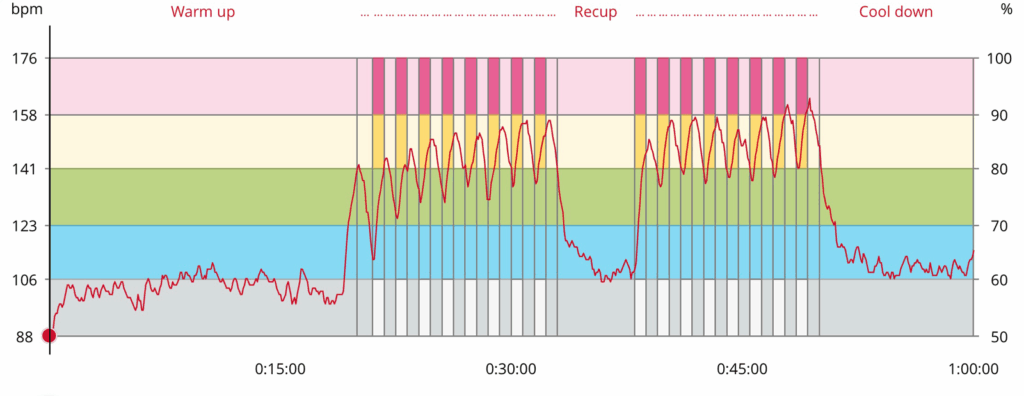
- ENDURANCE: monitoring your HR allows you to stay in the optimal zone for strengthening your cardio-respiratory system. Aerobic capacity
- INTERVAL TRAINING: rapid changes in HR allow you to focus primarily on your anaerobic capacity and VO2max.
HR helps you analyze periods of effort and recovery, and adjust your overall training load.
Heart rate is a simple, accessible, and extremely effective tool for structuring and optimizing sports training.
When analyzed properly, it can be used to adjust intensity, improve progress, and prevent overtraining.
Incorporating HR into your training is a reliable and effective way to achieve your performance or health goals.
To take your training to the next level and optimize your workouts, use our Elitesport calculators :